Two lines out of the Ice Age
Your direct maternal and paternal lines both trace to the Western Hunter-Gatherers — Europe's people before farming. This page follows them from the glacial refuges to the present day: where they went, who documentably shares them, and where their nearest living relatives are now.
Mother → her mother → her mother, unbroken. U5 arose in Europe ~30,000–35,000 years ago — the signature lineage of the European Mesolithic.
7 derived, 4 excluding markers · high confidenceFather → his father → his father, unbroken. I-M423. Haplogroup I is the one major lineage that appears to have originated in Europe.
Called on the full ISOGG tree · M223 branch excludedOut of the refuges
At the height of the last Ice Age, ~21,000 years ago, Europe's hunter-gatherers were pressed into a handful of southern refuges. As the ice pulled back, they walked north again — and your two lines are branches of that recolonisation. The sea was ~120 m lower; Britain was joined to the continent by Doggerland, now under the North Sea.
People who share these lines — from the ground
Not statistical cousins: sequenced individuals in the scientific literature carrying the same haplogroups. Photographs are of the actual remains, freely licensed from Wikimedia. Cheddar Man and Loschbour man each carry a line of yours — Loschbour carries both — because these are Western Hunter-Gatherer lineages.
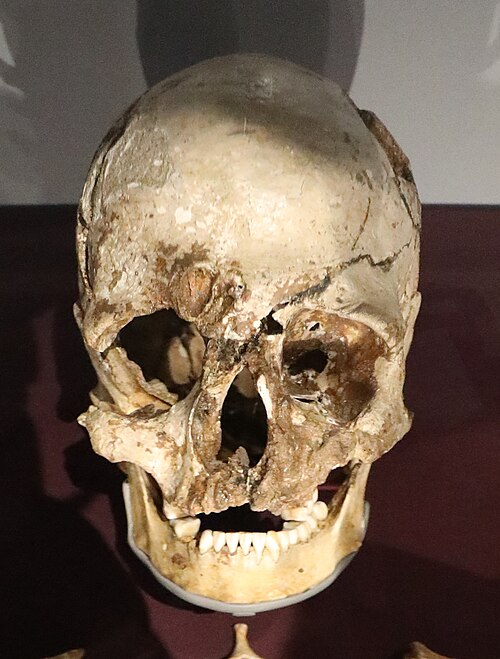
Cheddar Man
c. 7100 BC · Somerset, England
mt U5b1 Y I2a
Britain's oldest complete skeleton. The 2018 sequencing found dark skin, blue eyes — and both of your haplogroups.
Skull photo © geni, CC BY-SA 4.0 · Wikipedia

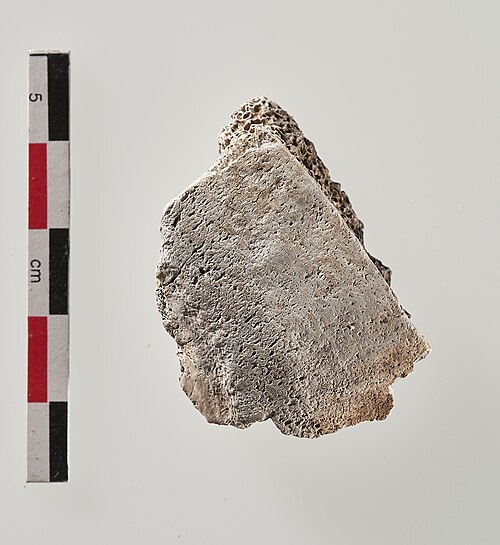


La Braña 1
c. 5000 BC · León, Spain
mt U5b2c1 Y C1a2
The genome that first revealed the hunter-gatherer combination of dark skin and blue eyes. No free photograph exists — this is an illustration.
Drawing (this project) · Wikipedia
Where the lines went
The two lines have very different recent histories, and it is worth keeping them apart.
The paternal line, I-M423, has a dramatic last two millennia. Its "Dinaric" sub-branch (I-CTS10228) has a young founder — its explosive radiation node dates to roughly 2,200 years ago, the Iron Age, and it is essentially absent from ancient remains until the Early Middle Ages, then appears suddenly across Eastern and Southeastern Europe. That broadcast lines up with the medieval Slavic migrations of the 6th–9th centuries — a genuinely large movement that ancient DNA now confirms replaced more than 80% of the local gene pool in parts of Central Europe and the Balkans. It turns up in the 10th-century Hungarian Conqueror elite (as I-L621) and in Viking-age burials at Chernihiv, Gotland and Kraków.
An honest hedge on the word "Slavic." That the lineage spread with early-medieval migrations is well demonstrated. Whether I-CTS10228 is a "Slavic ethnic marker" is contested: its founder predates the Slavs by centuries, and some scholars read the South-Slavic peak as a pre-Slavic Balkan population that the incoming Slavs absorbed, rather than a signal the Slavs brought with them. The cleanest proof that a Y-line is a poor proxy for an ethnicity: the Turkic-speaking Gagauz carry this marker at ~24%, while the Slavic-speaking Sorbs of Germany carry it at only ~4%. So: your paternal branch is deeply tied to this Eastern/Southeastern European world — but the neat story "your fathers were Slavs" is an inference, not a settled fact.
The maternal line, U5b, is older and quieter. It never had a single expansion event like that; it has persisted in Europe since the Mesolithic, thinned and overlaid by later farmer and steppe migrations, surviving best at the continent's edges (see §5).
Documented carriers of the last two millennia
Here honesty has to lead. A shared haplogroup makes someone a relative on one line — a shared ancestor, usually many centuries back — not your ancestor. And when you ask the records for named, documented carriers of these exact branches, the list is short and revealing.
| Named carrier | When / where | Line | Grade |
|---|---|---|---|
| Knez Mirko Radojević Bosnian magnate under King Tvrtko I |
late 14th c. Kopošići, Bosnia | Y I2a-Din | A/B |
| Knez Batić Mirković his son, knez under Tvrtko II |
d. c. 1430 Kopošići, Bosnia | Y I2a-Din | A/B |
| Karađorđe Petrović leader, First Serbian Uprising |
1768–1817 Serbia | Y I2a-CTS10228 | B |
| Živojin Mišić Serbian field marshal, WWI |
1855–1921 Serbia | Y I2a-CTS10228 | B |
The two Bosnian knezovi — father and son, real titled magnates buried under carved stećak tombstones — are the strongest documented noble case that exists for this paternal branch. The haplogroup is predicted from Y-STRs rather than SNP-tested, so it is graded A for the identification, B for the call. The two Serbian figures come from a respected volunteer project (the Serbian DNA Project), not a journal — hence B. Notice what they share: all four are of this Eastern/Balkan world, all military or political, none cultural.
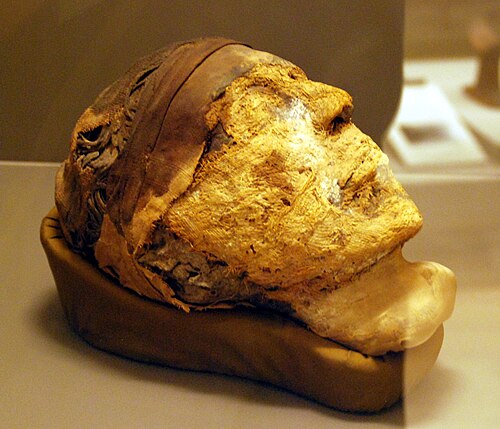
Claims to throw away. The internet attaches this paternal line to Nikola Tesla — false; he was cremated, and a documented Tesla relative tests R1a. And to Martin Luther — surname-matching and commercial marketing, no verified descendant. The one time U5b touches a named king in the literature — a mummified head attributed to Henri IV of France — the relic was later refuted as a misidentification. None of these survives scrutiny.
One real noble house — and no crown
The honest answer: no reigning dynasty sits on either of your lines. Every royal house with actual DNA evidence resolves elsewhere — the Rurikids of Russia are N1a, the Árpáds of Hungary R1a, the Bourbons of France R1b, England's Richard III haplogroup G. The rumoured Karađorđević and Obrenović royal attributions are unsourced.
What you do have is genuine lesser nobility: the Radojević–Mirković knezovi of Bosnia. Not kings — regional magnates, the Balkan equivalent of a titled baronial family, sworn men of the Kotromanić crown. That is a real, documented aristocratic connection on your paternal branch, and it is more than most lineages can show.
Kopošići, above the Bosna valley, in the reign of Tvrtko. The seat is not a French château but a kula — a square stone tower-house of the Dinaric lords, walls a metre thick, narrow windows set high, a timber gallery under the eaves. Below it the household's gathered dead lie beneath stećci: great limestone slabs and gabled chests carved with spirals, vine-scrolls, a raised hand, a hunt, a circle-dance of figures with joined arms. When Knez Mirko was laid there they wrapped him in a gilded silver funerary mantle — it survives, in the National Museum in Sarajevo, beside the famous Haggadah.
No coat of arms is recorded for this particular house, so none is invented here. The Kotromanić kingdom they served bore a bend — a diagonal band — and a crowned arm with a sword; the great Bosnian families carried variations of shield, crescent and star. Picture Mirko's banner among them at Tvrtko's court, and you are within the range of the plausible — but this paragraph is historical reconstruction of his world, not a record of your descent. You share his paternal branch. Whether you share his particular family, the DNA cannot say.
The eloquent silence
You asked whether any outstanding physicians, philosophers, scientists, artists, architects or engineers shared these lines. I went looking hard, and the answer is itself the finding: not one, at reliable evidence. Wikipedia's list of historic people's haplogroups contains zero U5 entries of any kind, and a single I2a1b entry that collapses on inspection.
This absence is structural, not a gap in the search. To document a historical person's haplogroup you need either their studied remains or an unbroken pedigree to a living descendant — and both have been lavished on Western European royalty and the canonical composers, exactly the populations where these two branches are rarest. The Balkans, where your paternal line peaks, has had almost no elite-remains genomics. The silence is about who gets studied, not about the worth of the line.
The contrast is sharp when you line up the cultural figures who have been tested — every one lands on a different branch:
| Figure | Their haplogroup | On your line? |
|---|---|---|
| Ludwig van Beethoven | Y I1-Z139 · mt H1b1 | No — I1, the opposite branch of I |
| Nicolaus Copernicus | mt H | No |
| Leonardo da Vinci | Y E1b1b (provisional) | No |
| Thomas Jefferson | Y T-M184 | No |
| Richard III of England | mt J1c2c3 · Y G | No |
Read it the other way and it is rather fine: your lines are not those of the crowned and the catalogued. They are the deep-rooted European substrate — the hunter-gatherers who were already here, and the peoples who remade the east in the Middle Ages. A different kind of ancestry, older than any dynasty.
Your nearest living relatives
Where do people carrying your two lines cluster today? Two very different corners of Europe — one for each line. (These are population frequencies from published genetics; they describe who carries the branch, not a personal match. Percentages are approximate and vary between studies.)
Herzegovina and the Bosnian-Croat highlands hold the world peak for this paternal line. Modern Croatia is ~39% haplogroup I2a overall.
U5b's specifically northern peak is the Sami (much of it U5b1b1); U5 as a whole is scattered thinly across all of Europe.
The two peoples, drawn
If you wanted to stand among the largest living concentrations of your paternal and maternal relatives, you would go to two very different places. The costume, dwelling and object drawings below are general ethnographic depictions of these cultures, not claims about your family.
The paternal peak — the Dinaric South Slavs
Peoples: Bosnians, Croats, Serbs, Montenegrins · Language: Bosnian/Croatian/Serbian/Montenegrin (BCMS) · Family: South Slavic → Slavic → Indo-European
Men: white homespun, a woven red sash, a dark embroidered jacket, the soft šajkača cap, leather opanci with upturned toes. Women: a pleated linen shift, an embroidered jelek vest, a woven wool apron in geometric reds and golds, a coin-hung cap.
The kula: a square stone tower-house, thick walls, tiny defensive windows, a timber gallery beneath a low hipped roof — a fortified home for a land of feud and frontier.
The gusle: a single horsehair string over a carved maple bowl, bowed while reciting epic poetry — the instrument of the Dinaric bard, unchanged for centuries.
The maternal peak — the Sami of the North
People: the Sami (Sápmi: N. Norway, Sweden, Finland, Kola) · Language: the Sami languages · Family: Uralic — unrelated to the Indo-European paternal side
The gákti: a deep-blue wool tunic or dress banded in red and yellow at hem, cuffs and collar, cinched with a worked belt, over reindeer-hide boots. The men's four-winds hat and the women's red bonnet are the signatures.
The lavvu: a portable conical tent of poles and cloth (once reindeer hide), built to shrug off Arctic wind and strike in minutes — the home of a people who followed the herds.
The goavddis (noaidi drum): a shallow bowl or frame of birch, its reindeer-skin head painted with sun, herds and spirits — struck by the noaidi to travel between worlds.
These two peoples could hardly be more different — a South Slavic, Indo-European, highland world, and a Uralic, reindeer-herding Arctic one — and they do not descend from each other. That is exactly the point of two independent lines: your father's fathers and your mother's mothers walked out of the same Ice Age into utterly different destinies.
Two lines, not a family tree. Haplogroups trace only your mother's-mother's-mother line and your father's-father's-father line. Ten generations back you had ~1,024 ancestors; these two describe two of those paths. Everyone named here who "shares" a line is a relative on that one line — a common ancestor far back — never a proven ancestor of yours.
No admixture percentages appear here. "38% Baltic, 12% Finnish" needs comparison against reference population panels, which a raw genotype file alone cannot support — so I have not invented any. The frequencies in §5 describe populations, not a personal match.
How the paternal branch was resolved. The call used yhaplo across 3,741 Y markers, with every coordinate lifted GRCh38→GRCh37 through the UCSC chain (the offset is not constant, so a flat shift would mis-call it) and checked against a known address. Result: I2a1b (I-M423), with I2a2/M223 excluded by six ancestral markers. The Slavic "Din" marker CTS10228 itself is not on this chip, so placement within M423 is not fully settled — one downstream twig (S17250) is excluded, Din membership remains open.